Background
The sharp increase in metabolic diseases related to obesity during the last 2 decades has led to the term « civilization diseases ». The prevalence of pathological obesity, type 2 diabetes (T2D) and non-alcoholic fatty liver diseases (NAFLD) has doubled and will triple in the next decade. NAFLD is present in 25–30% of the general population and in 75% of patients with obesity or T2D and leads to cirrhosis and hepatocellular carcinoma. Their management is associated with high healthcare costs. They are a priority in public health and deserve a prominent interest in experimental and translational clinical research. It is worth noting the quasi-absence of biomarkers of responsiveness to therapies and the relatively limited success of biologicals and chemical drugs to treat pathological obesity and related diseases. The societal impact of metabolic diseases is major in the Region Grand Est. About a quarter of the population of the Region Grand-Est is affected by obesity, particular in children and adolescents.
ancien
General design
ARRIMAGE is structured at the crossroads between three groups of diseases, adopting an integrated approach to mechanisms, biomarkers, therapeutics and quality of care (Figure).
WP1 will focus on the similarities behind the interdependent pathomechanisms in the three disease groups, by considering nutrition, foetal programming, 1-CM, epigenomics, innate immunity, cellular stress and inflammation, regeneration and matrix remodeling. WP2 will evaluate existing biomarkers of stratified medicine and identify new ones able to predict, diagnose and monitor patients. The biomarkers evaluated relate to mechanisms studied in WP1.
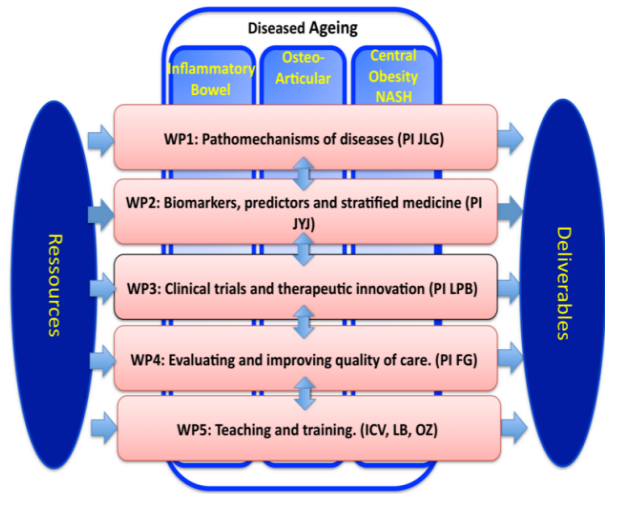
They will be studied in WP3 in the design of innovative therapeutics and in WP4 for their predictive value of future events and their interest in decision criteria for therapeutic choices. WP3 includes clinical trials coordinated by members of ARRIMAGE and explores novel therapeutic strategies arising from WP1. WP4 aims to evaluate prevention strategies and improve quality of care through the complementary expertise of CIC-EC, clinical departments and research teams. The optimization of care will be subject to medico-economic assessment and decision-making evaluation and will improve the training of interns in WP5
Ambition and added value of ARRIMAGE
By unveiling novel pathophysiological aspects of diseased ageing, our ambition is to better prevent and treat the 3 groups of age-related diseases, OAD, IBD and diseased obesity. Through its approach targeting the crossroads of these 3 groups of diseases, ARRIMAGE is a unique initiative in the French medical landscape, whose ambition is also to identify and validate new biomarkers and to promote therapeutic innovation and quality of care of the common severe outcomes of these diseases.
The added value of ARRIMAGE relies on a cross-disciplinary leading expertise of the teams and PIs at the international and national level. Thanks to a transdisciplinary project, we plan to optimise the medical care and the clinical and experimental research by sharing our expertises and our resources in cohorts, experimental models and state-of-the-art technical tools (Figure 3). Our goals fit perfectly into the priority of the CHU of Nancy and the University of Lorraine (UL) as regards “Normal and pathological aging: mechanisms and consequences on population health”. ARRIMAGE gathers expertise in 5 out of the 9 translational research-axes of the University Hospital of Nancy, namely metabolism and genomics, OAD and biomarkers, inflammatory diseases, functional or metabolic imaging, biomarkers and transcriptomics and modelling.